
Hyaluronic acid in fillers
Product names are trademarks of their respective owners. LookPrep is independent and is not affiliated with, sponsored by, or endorsed by any manufacturer. Names are used only to identify the products a person may discuss with a qualified provider.
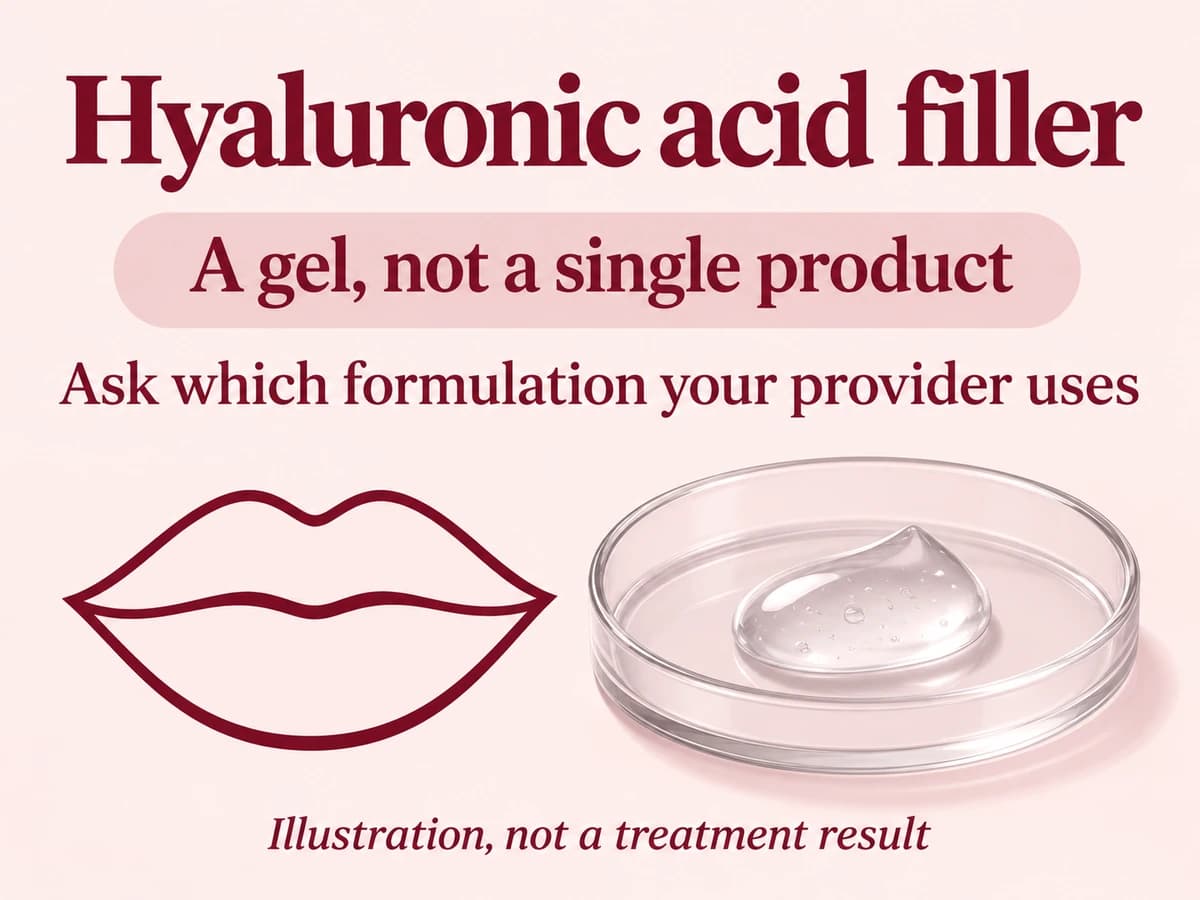
What crosslinked hyaluronic acid means
Natural hyaluronic acid breaks down quickly in the body. To make an injectable dermal filler, manufacturers chemically link HA chains together in a process called crosslinking. The FDA describes crosslinking as a way to help the gel last longer in tissue rather than being absorbed right away.
Knowing that a filler contains crosslinked HA tells you the base material, not how the gel will behave. Manufacturers adjust crosslinking design, gel concentration, and particle structure to create very different products. Two fillers can both be listed as crosslinked HA and still differ in feel, approved treatment areas, and how long results tend to last.
Source 1, listed at the end of this page.
How long hyaluronic acid filler lasts
The short answer is about 6 to 12 months. That is the FDA’s general estimate for temporary hyaluronic acid fillers, not a guaranteed timeline or an expiration date for your result.
In practice, longevity varies from person to person and from gel to gel. Several factors shape how long an HA filler remains noticeable:
- The specific formulation: Different crosslinked HA gels are engineered for different levels of support and persistence.
- Where it is injected: High-movement areas, such as the lips and skin around the mouth, often behave differently than less mobile areas of the face.
- Individual response: Your body’s natural breakdown rate affects how gradually the gel fades.
Rather than relying on a general "HA filler" timeframe, ask your provider what duration range is documented for the exact product and area you are considering.
Sources 1 and 2, listed at the end of this page.
Read past the material name
In the United States, the FDA does not approve hyaluronic acid broadly for every part of the face. Instead, regulators evaluate each specific formulation for defined anatomical areas and outcomes. Restylane Kysse, for example, contains crosslinked HA and lidocaine, a local anesthetic added to reduce discomfort during injection. In the United States, Restylane Kysse is approved for lip augmentation and for correcting lines in the skin of the upper lip area (upper perioral rhytids) in patients over 21. Another HA gel may have been assessed in a different area or against a different outcome.
A price quote, treatment menu, or visual simulator often lists only the material category. Treat "hyaluronic acid" as a starting point and get the full details:
- Record the exact product name: Write down every word and suffix, such as
XC,L, or a plus sign (+), which can indicate added lidocaine or a distinct formulation. - Check the U.S. patient leaflet: Use that exact name to look up the FDA-approved patient labeling, including the approved uses, common injection-site reactions, and safety warnings.
- Confirm whether your area is on-label: Ask whether the product was specifically approved for the area you want treated or whether your provider is proposing an off-label use.
Sources 1, 2 and 3, listed at the end of this page.
Compare the question each study asked
Headline durability claims on brochures or clinic websites rarely tell the full story. When you review a product’s FDA clinical summary, look closely at how the study defined a maintained result:
- Who evaluated the outcome: A blinded clinician grading fullness on a clinical scale can reach a different result than participants rating their own satisfaction or appearance.
- What scale was used: One trial may measure lip fullness while another measures smoothness of lines around the mouth, each with its own threshold for improvement.
- Whether retreatment was offered: Check which follow-up visit produced the headline number and whether participants could receive an additional treatment during the study.
In the Restylane Kysse clinical evidence, a blinded evaluator’s fullness score and a participant’s assessment of appearance used different scales. In that study, every participant was offered optional retreatment at the 48-week visit if the result had not been maintained. A study visit schedule shows how a product was tested under trial rules, not when you should schedule your own follow-up.
Source 3, listed at the end of this page.
HA fillers with a U.S. lip indication on LookPrep
Each product page below summarizes the filler’s U.S. indication, clinical study findings, and reactions recorded in its FDA summary so you can compare formulations side by side. Eight of these fillers have a U.S. lip-augmentation indication. RHA Redensity is listed for lines around the mouth only.
- Restylane KysseU.S. approval for lip augmentation and lines around the mouth, 2020 (P140029/S021)
- Juvéderm Volbella XCU.S. approval for lip augmentation and lines around the mouth, 2016 (P110033/S018)
- Juvéderm Ultra XCU.S. approval for lip augmentation, 2015 (P050047/S044)
- Restylane SilkU.S. approval for lip augmentation and lines around the mouth, 2014 (P040024/S072)
- Restylane-LU.S. approval for lip augmentation, 2012 (P040024/S056)
- RHA 3U.S. approval for lip augmentation, 2023 (P170002/S030)
- Revanesse Lips+U.S. approval for lip augmentation, 2020 (P160042/S010)
- Belotero Intense (+) LidocaineU.S. approval for lip augmentation, 2026 (P250016)
- RHA RedensityU.S. approval for lines around the mouth only, not lip augmentation, 2021 (P170002/S012)
Take the label to your consultation
Bring the full product name from your quote and use these questions to keep the discussion grounded in the product’s actual labeling:
- Which exact formulation is being proposed? Ask for the complete product name, including any suffix, and confirm whether it contains lidocaine.
- What does its U.S. label say about the area I am considering? Clarify whether that treatment area is FDA-approved for this specific gel or an off-label use.
- What timeline and short-term reactions should I expect from this product? Ask what duration is typical in your target area and what recovery signs to plan around.
- How will we decide whether the result was worth the treatment, follow-up, and cost? Set clear expectations upfront so you have a practical benchmark before considering any future touch-up.
Private preview
Bring a picture of your goal to the consultation
- Free Natural preview · 8 previews $19 · 20 previews $29
- Private by default
- Delete on request
Sources and review status
Material properties and U.S. product labelling. Sources checked on . This editorial reference has no clinical reviewer. Suggest a correction.
- FDA-Approved Dermal Fillers · U.S. Food and Drug Administration · source dated
- Dermal Fillers (Soft Tissue Fillers) · U.S. Food and Drug Administration · source dated
- Restylane Kysse · FDA safety and effectiveness summary, P140029/S021 · U.S. Food and Drug Administration