
Restylane-L
Product names are trademarks of their respective owners. LookPrep is independent and is not affiliated with, sponsored by, or endorsed by any manufacturer. Names are used only to identify the products a person may discuss with a qualified provider.
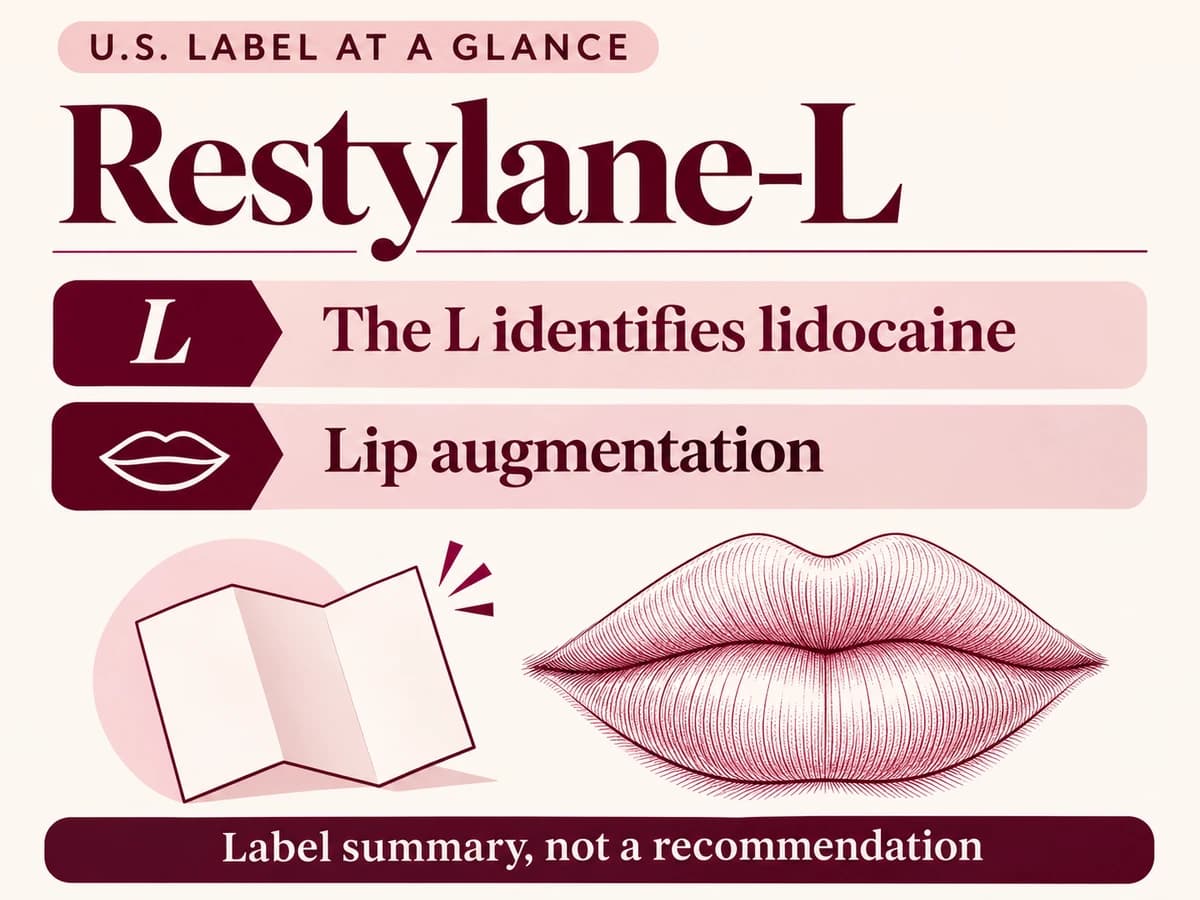
At a glance
- Exact product name
- Restylane-L
- Applicant on the FDA summary
- Medicis Aesthetics Holdings, Inc.
- FDA record (PMA supplement)
- P040024/S056
- FDA approval of this supplement
- What the U.S. label covers
- Submucosal implantation for lip augmentation (the record also covers moderate to severe facial wrinkles and folds)
- Contains lidocaine
- Yes, 0.3%
- Hyaluronic acid concentration
- 20 mg/mL, crosslinked
- Minimum age on the label
- Over 21 for lip augmentation
Checked against the FDA summary and the FDA database entry on . Sources 1 and 2, listed at the end of this page.
Reading the U.S. label
The "-L" in Restylane-L identifies the formulation with 0.3% lidocaine, a local anesthetic added to a 20 mg/mL crosslinked hyaluronic acid gel. Clinic menus, brochures, or records headed simply "Restylane" may refer to the lidocaine-free formulation rather than Restylane-L.
That distinction matters when reading the U.S. FDA record. Approved on August 30, 2012, the approval covers submucosal lip augmentation in patients over 21 as well as moderate to severe facial wrinkles and folds, and does not cover perioral lines. In the FDA summary, lip-augmentation evidence and 14-day lip reaction diaries come from earlier studies of Restylane without lidocaine, while the Restylane-L discomfort comparison measured injection pain in nasolabial folds rather than in the lips.
Because product names in the same brand family look nearly identical on charts and consent forms, bring the exact name or a copy of any previous treatment record to your consultation. Let your clinician know in advance if you have severe allergies, a bleeding disorder, an allergy to gram-positive bacterial proteins, or any prior reaction to amide-type local anesthetics such as lidocaine.
Source 1, listed at the end of this page.
What the study measured and found
One double-blind study in the FDA summary (MA-1100-001) compared how the same 60 participants rated injection discomfort with and without lidocaine in the folds beside their noses. Each participant received Restylane-L in one nasolabial fold and Restylane without lidocaine in the other. At the end of injection, 71.7% rated pain on the Restylane-L side at least 10 mm lower on a 100 mm visual analogue scale, with average scores of 14.7 mm versus 44.9 mm. That study was first submitted for an earlier Restylane-L approval (P040024/S039) and is summarised again in this record. The lip-augmentation studies this record relies on evaluated Restylane without lidocaine and were described under supplement P040024/S051. Because MA-1100-001 measured injection pain in facial folds rather than lips, it cannot tell you what shape or outline to expect after lip augmentation.
Study details · Participants, in a double-blind study
- Participants
- 60 participants treated in opposite nasolabial folds, one with Restylane-L and one with Restylane without lidocaine (study MA-1100-001)
- What was measured
- Share of participants whose pain score was at least 10 mm lower on the Restylane-L side, on a 100 mm visual analogue scale
- Assessed by
- Participants, in a double-blind study
- Assessment time
- At the end of injection
- Source checked
Source 1, listed at the end of this page.
Reactions recorded in the study
This FDA record does not report a separate lip diary for Restylane-L itself. Instead, it cites the lip study of Restylane without lidocaine (MA-1300-15), where participants recorded at least one adverse outcome in a 14-day daily diary after their first treatment in 97.1% of upper lips and 94% of lower lips. Commonly reported outcomes were pain, swelling, tenderness, bruising, and redness. Onset was typically within a day and resolution usually within 15 days, while 15% of participants experienced outcomes—typically swelling and tenderness—that lasted longer than 15 days.
The FDA summary states that Restylane-L is contraindicated for people with severe allergies (a history of anaphylaxis or multiple severe allergies), allergies to gram-positive bacterial proteins, or bleeding disorders, and should not be used by people who have reacted to amide-type local anesthetics such as lidocaine.
Source 1, listed at the end of this page.
A question to take with you
When you describe an expected benefit or recovery timeline, was it studied in lips with Restylane-L specifically, or with another Restylane formulation?
Asking this helps clarify whether your clinician is drawing on the lidocaine-free Restylane lip studies—where swelling and tenderness lasted beyond 15 days for 15% of participants—or on the facial-fold pain study, and whether your planned treatment stays within the U.S. lip augmentation approval rather than extending to areas such as perioral lines.
Simulator
Restylane-L simulator
This simulation uses the Restylane-L preset. Simulator setting: A balanced direction for shaping the lip outline with natural-looking fullness. This describes the simulated image, not a labelled or studied effect. A real treatment may look different.
Amounts you can preview
The preset illustrates classic shaping and natural fullness. It opens at 1.0 mL. Each amount below is a simulator setting.
- 0.5 mL
- 1.0 mL
- 1.5 mL
- 2.0 mL
Looks it is used to approximate
LookPrep renders product and dose, not placement. LookPrep maps this product as an approximation for these styles; this is not a source-backed product recommendation and the preview does not reproduce the technique.
There is no stored demo face for Restylane-L. The photo preview uses the settings listed above.
LookPrep is not a medical provider and does not sell or administer treatment. A preview is an illustration, not a prediction. Product choice, amount, placement and candidacy are decisions for a qualified clinician, and the product labeling and consent discussion remain the authority.
Private preview
Bring a picture of your goal to the consultation
- Free Natural preview · 8 previews $19 · 20 previews $29
- Private by default
- Delete on request
Sources and review status
U.S. product labelling, study endpoints and recorded reactions. Sources checked on . This editorial reference has no clinical reviewer. Suggest a correction.
- Restylane-L · FDA safety and effectiveness summary, P040024/S056 · U.S. Food and Drug Administration
- Restylane-L · FDA PMA database entry, P040024/S056 · U.S. Food and Drug Administration