
Revanesse Lips+
Product names are trademarks of their respective owners. LookPrep is independent and is not affiliated with, sponsored by, or endorsed by any manufacturer. Names are used only to identify the products a person may discuss with a qualified provider.
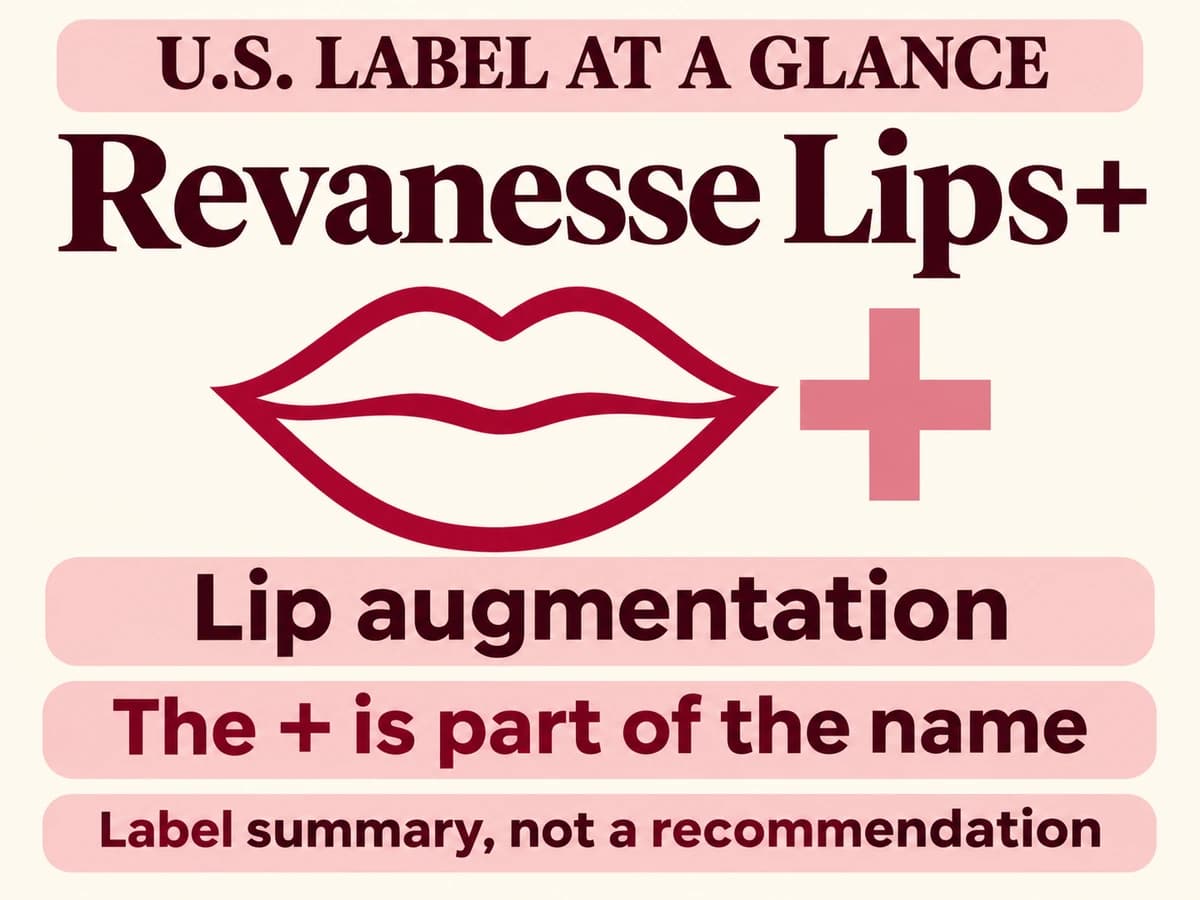
At a glance
- Exact product name
- Revanesse Lips+
- Applicant on the FDA summary
- Prollenium Medical Technologies Inc.
- FDA record (PMA supplement)
- P160042/S010
- FDA approval of this supplement
- What the U.S. label covers
- Submucosal implantation for lip augmentation
- Contains lidocaine
- Yes, 0.3%
- Hyaluronic acid concentration
- 22 to 28 mg/mL, crosslinked
- Minimum age on the label
- 22 or older
Checked against the FDA summary and the FDA database entry on . Sources 1 and 2, listed at the end of this page.
Reading the U.S. label
The FDA summary identifies Revanesse Lips+ as having the same crosslinked hyaluronic acid formulation (22 to 28 mg/mL with 0.3% lidocaine) as Versa+. The supplement linked here (P160042/S010) specifically establishes U.S. approval for submucosal lip augmentation in adults aged 22 or older, and it does not include perioral lines around the mouth. The plus sign belongs to the product name; it does not describe a larger syringe, extra volume or a stronger augmentation effect.
When reviewing the clinical data on the label, it helps to notice what the pivotal study was built to show. The trial was a two-month non-inferiority comparison designed to confirm that Lips+ was no more than 0.5 grades worse than an approved comparator filler, not to prove superiority or full-year longevity. Because the primary per-protocol analysis evaluated 54 and 55 participants out of the 158 randomised and scored overall fullness of both lips together, the headline gain tells you that short-term volume increased—not how upper-to-lower lip proportions or border definition looked.
The safety section also requires careful reading. Rather than separating out 30-day patient diary percentages, the FDA summary reports treatment-emergent adverse events across the roughly 10-month initial study, so raw figures should not be compared directly across brands that tabulate diary entries differently. Even so, the high rates of swelling (87.5%) and bruising (71.3%)—and the fact that 9.3% of recorded events lasted more than 31 days, despite 66.5% resolving within 0 to 7 days—are practical reasons to build recovery buffer time around major photos or events and to review every allergy or bleeding contraindication with your injector beforehand.
Source 1, listed at the end of this page.
What the study measured and found
The pivotal study randomised 158 participants in equal proportions to Revanesse Lips+ (80) or another approved filler, which the FDA summary calls the Comparator (78). At two months, a blinded investigator assessed overall fullness of both lips together. In the per-protocol population, mean improvement was 1.52 grades with Lips+ and 1.53 with the comparator (95% confidence interval for the difference: −0.33 to 0.31), meeting the non-inferiority test of being no more than 0.5 grades worse. At least a one-grade improvement was recorded for 90.7% (49 of 54) with Lips+ and 92.7% (51 of 55) with the comparator. Because this endpoint scores both lips together, it cannot show how fullness was distributed or whether upper-to-lower lip proportions matched individual goals.
Study details · Blinded evaluating investigator
- Participants
- 158 participants randomised 1:1 to Revanesse Lips+ (80) or an approved comparator filler (78); per-protocol analysis of 54 and 55
- What was measured
- Change from baseline in overall fullness of both lips together, tested for non-inferiority with a 0.5-grade margin
- Assessed by
- Blinded evaluating investigator
- Assessment time
- Two months
- Source checked
Source 1, listed at the end of this page.
Reactions recorded in the study
Rather than breaking out 30-day diary percentages separately, the FDA summary reports treatment-emergent adverse events across the initial study. Among the 80 participants treated with Revanesse Lips+, the most common were injection site swelling (87.5%), bruising (71.3%), pain (21.3%) and facial asymmetry (15.0%), compared with 89.7%, 56.4%, 30.8% and 10.3% among the 78 comparator participants. Across all 257 adverse events recorded with Lips+, 66.5% resolved within 0 to 7 days and 9.3% lasted longer than 31 days.
The FDA summary lists several key contraindications, including a history of anaphylaxis or multiple severe allergies; allergies to hyaluronic acid products, streptococcal proteins, natural rubber latex or lidocaine; and bleeding disorders or current anticoagulant or antiplatelet therapy.
Source 1, listed at the end of this page.
A question to take with you
Can we describe what I want to keep about each lip before discussing a change in overall fullness?
You can also ask whether your treatment plan stays strictly within lip augmentation rather than lines around the mouth, how much swelling or bruising recovery time to plan for, and whether any of your allergies or medications affect your eligibility for a lidocaine-containing hyaluronic acid filler.
Private preview
Bring a picture of your goal to the consultation
- Free Natural preview · 8 previews $19 · 20 previews $29
- Private by default
- Delete on request
Sources and review status
U.S. product labelling, study endpoints and recorded reactions. Sources checked on . This editorial reference has no clinical reviewer. Suggest a correction.
- Revanesse Lips+ · FDA safety and effectiveness summary, P160042/S010 · U.S. Food and Drug Administration
- Revanesse Lips+ · FDA PMA database entry, P160042/S010 · U.S. Food and Drug Administration