
RHA Redensity
Product names are trademarks of their respective owners. LookPrep is independent and is not affiliated with, sponsored by, or endorsed by any manufacturer. Names are used only to identify the products a person may discuss with a qualified provider.
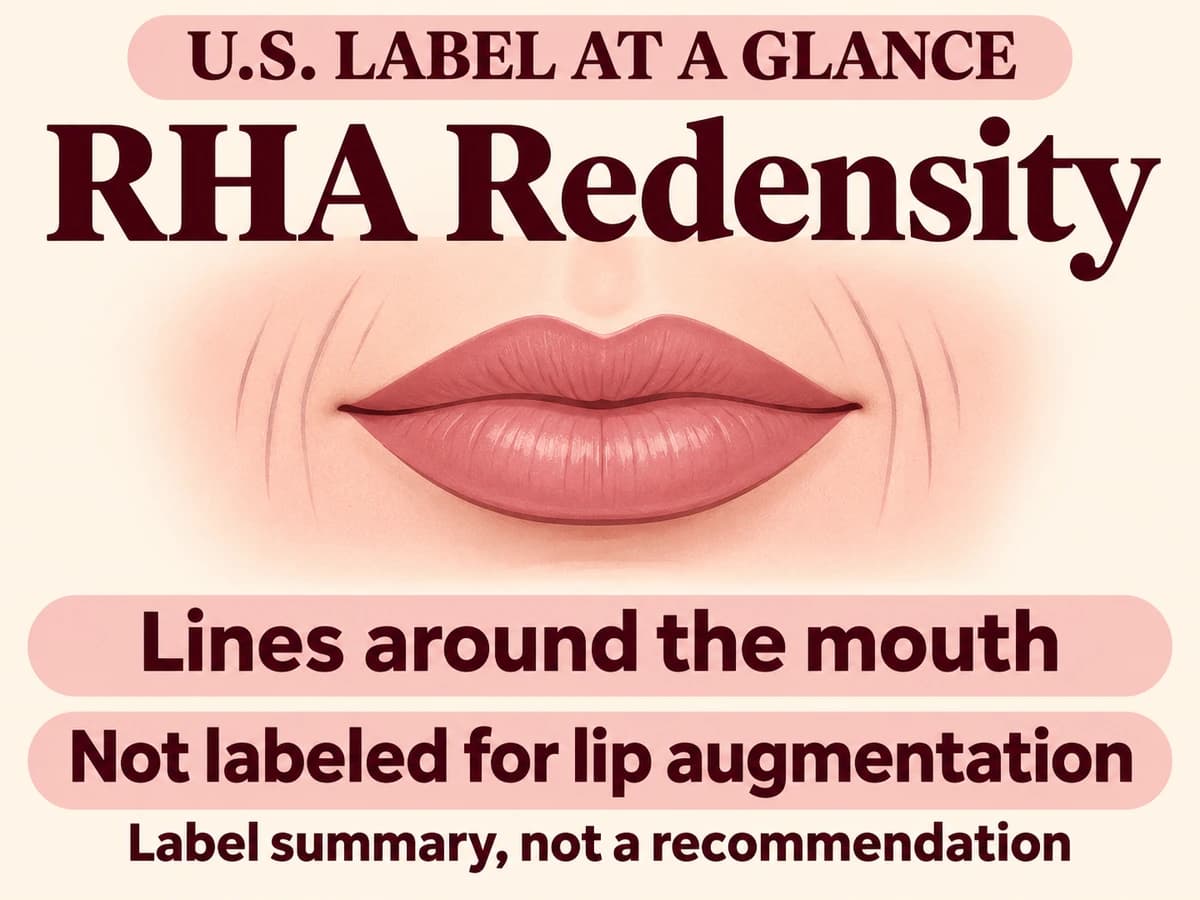
At a glance
- Exact product name
- RHA Redensity
- Applicant on the FDA summary
- TEOXANE SA
- FDA record (PMA supplement)
- P170002/S012
- FDA approval of this supplement
- What the U.S. label covers
- Injection into the dermis and superficial dermis of the face for moderate to severe dynamic perioral rhytids. This is not a lip-augmentation indication
- Contains lidocaine
- Yes, 0.3% lidocaine hydrochloride
- Hyaluronic acid concentration
- 15 mg/g, crosslinked and non-crosslinked
- Minimum age on the label
- Adults aged 22 or older
Checked against the FDA summary and the FDA database entry on . Sources 1 and 2, listed at the end of this page.
Reading the U.S. label
In the U.S. FDA approval record (PMA P170002/S012, approved December 22, 2021 for TEOXANE SA), dynamic perioral rhytids is the label’s term for lines in the skin around the mouth that appear or deepen with movement, such as talking, smiling, or pursing the lips. Cleared for adults aged 22 or older, this indication covers injection into the dermis and superficial dermis of the face using a 15 mg/g hyaluronic acid gel containing 0.3% lidocaine hydrochloride.
Because perioral lines sit directly next to the lips, RHA Redensity is often shown alongside lip treatments in patient guides or clinic diagrams. Even so, this approval covers only the surrounding skin—not lip augmentation. Selecting RHA Redensity in a lip illustration is not evidence of a U.S. FDA indication for adding volume to the lips themselves.
Keeping that boundary in mind clarifies what the FDA clinical evidence supports. In the eight-week study, a blinded evaluator graded wrinkle severity around the mouth rather than lip fullness, so the reported improvement demonstrates effectiveness for dynamic perioral wrinkles rather than lip volumizing. Likewise, the 14-day participant diaries reflect superficial perioral injections—where temporary bruising, swelling, redness, firmness, and lumps or bumps were common initially, with 76.4% resolving by day 7 and nearly 90% by day 14—and the label’s contraindications apply regardless of treatment area, ruling out use for anyone with severe allergies, allergies to gram-positive bacterial proteins, prior reactions to amide-type local anesthetics such as lidocaine, or bleeding disorders.
Source 1, listed at the end of this page.
What the study measured and found
The study randomised 202 participants with moderate or severe lines around the mouth: 150 to RHA Redensity and 52 to no treatment. At eight weeks, a blinded evaluator graded severity of perioral wrinkles. At least a one-grade improvement was recorded for 80.7% of Redensity participants (121 of 150) and 7.8% of the untreated group (4 of 51). A difference on that scale is evidence about wrinkles and cannot establish a change in the volume of the lip itself.
Study details · Blinded live evaluator
- Participants
- 202 participants with moderate or severe dynamic perioral lines randomised 3:1, 150 to Redensity and 52 to no treatment (51 assessed)
- What was measured
- At least one grade of improvement from baseline in perioral wrinkle severity
- Assessed by
- Blinded live evaluator
- Assessment time
- Eight weeks
- Source checked
Source 1, listed at the end of this page.
Reactions recorded in the study
In participant diaries during the 14 days after initial treatment, 175 of 199 treated participants (87.9%) recorded at least one common treatment response. This count pools the Redensity group and the untreated group after its delayed treatment. The most common were bruising (77.4%), swelling (73.4%), redness (65.8%), firmness (57.8%) and lumps or bumps (57.8%). Of all responses recorded, 76.4% had resolved by day 7, and the FDA summary says nearly 90% had resolved by day 14.
The FDA summary says RHA Redensity is contraindicated for people with severe allergies (a history of anaphylaxis or multiple severe allergies) or allergies to gram-positive bacterial proteins, and should not be used by people who have reacted to amide-type local anesthetics such as lidocaine or who have bleeding disorders.
Source 1, listed at the end of this page.
A question to take with you
Ask your injector directly: is this proposal aimed at softening lines that appear when I move my mouth, or at adding lip volume—and which U.S. FDA label applies to that goal?
If RHA Redensity is suggested for the lips rather than the surrounding skin, clarify whether that would be an off-label use and which products carry an explicit U.S. approval for lip augmentation. It is also worth confirming that nothing in your allergy history, lidocaine sensitivity, or bleeding risk triggers a contraindication, and checking how far ahead of photos or events to schedule treatment given the typical one- to two-week recovery window seen in the study diaries.
Private preview
Bring a picture of your goal to the consultation
- Free Natural preview · 8 previews $19 · 20 previews $29
- Private by default
- Delete on request
Sources and review status
U.S. product labelling, study endpoints and recorded reactions. Sources checked on . This editorial reference has no clinical reviewer. Suggest a correction.
- RHA Redensity · FDA safety and effectiveness summary, P170002/S012 · U.S. Food and Drug Administration
- RHA Redensity · FDA PMA database entry, P170002/S012 · U.S. Food and Drug Administration