
Lip filler
Product names are trademarks of their respective owners. LookPrep is independent and is not affiliated with, sponsored by, or endorsed by any manufacturer. Names are used only to identify the products a person may discuss with a qualified provider.
When to get help right away
Get emergency medical care right away if you have unusual pain, vision changes, or white, gray, or blue skin near your lips. These signs can start during treatment or soon after.
Also get emergency help for any sign of a stroke. Watch for sudden trouble speaking, face drooping, numbness or weakness in your face, arm, or leg, trouble walking, dizziness, confusion, or a severe headache.
The most serious risk is filler entering a blood vessel by mistake. It is rare, but it can cause lasting harm.
Aftercare and when to get help
Source · Dermal Fillers (Soft Tissue Fillers)
What lip filler changes and what to ask for
Your body breaks down approved lip filler over time, so keeping the look takes repeat visits. On U.S. labels, adding lip volume is called lip augmentation.
Before you book, look in a mirror and pick the exact change you want:
- Upper lip fullness: making your upper lip fuller.
- Lower lip fullness: making your lower lip fuller.
- Upper and lower balance: evening out the size difference between your upper lip and lower lip.
- Lip outline: making the outer edge of your upper lip, your lower lip, or both look clearer.
- Lines around the mouth: softening small wrinkles in the skin around the lips (called perioral lines on labels). This is a separate goal from lip fullness. Some fillers, such as Restylane Kysse, are approved for both lip fullness and lines above the upper lip.
Check your lips with your face relaxed and when you smile, since shape changes with movement. Bring one photo of each. If you bring a simulation, point to the exact part of your upper or lower lip you want to change. Ask if filler can match it. Waiting, or leaving your lips as they are, is always an option.
Sources 1 and 3, listed at the end of this page.
Risks and products to avoid
Lip filler can cause short-term side effects, lasting problems, or both. Most start soon after treatment and fade in days to weeks. Others appear weeks, months, or years later.
Even FDA-approved fillers carry risks:
- Common: bruising, redness, swelling, pain, tenderness, itching, and rash.
- Less common: infection, open or draining wounds, a sore at the treated spot, allergic reactions, and tissue death (necrosis). Raised bumps under the skin (nodules or granulomas) can also form and may need injections, antibiotics, or surgery. Swelling or redness can flare up later after an illness, infection, vaccine, or dental visit.
- Rare: severe allergic reaction (anaphylactic shock), permanent hard lumps, filler moving out of place (migration), filler leaking or breaking through the skin, and death. Filler can also enter a blood vessel by mistake. That can cause tissue death, vision problems including blindness, or stroke.
Avoid these unapproved products and devices:
- Fillers sold directly to the public: Approved fillers require a prescription. Products sold online or over the counter are not FDA-approved and may be fake or contaminated.
- Needle-free filler devices: High-pressure pens are not FDA-approved for fillers. They cannot control where the gel goes and have caused serious, lasting harm to the skin, lips, and eyes.
- Permanent fillers and injectable silicone: Permanent fillers are not FDA-approved for the lips. Injectable silicone is not approved for any cosmetic use.
Sources 1 and 2, listed at the end of this page.
Other options besides lip filler
Filler is not the only way to change how your lips look. Other choices include:
- Waiting or skipping treatment: Taking time after a consultation, or choosing no procedure, avoids medical risks and repeat visits.
- A lip flip: A provider places small doses of botulinum toxin, such as Botox, along the lip edges and mouth corners. It relaxes the muscle so the upper lip rolls slightly outward and looks a bit fuller. It does not add volume to your upper or lower lip.
- Everyday makeup: Lip liner, tint, or gloss can make your upper lip, lower lip, or both look fuller or sharper for the day. It carries no recovery time and no medical risk.
Talk with a licensed provider to see which option, if any, fits your goal.
Sources 4 and 2, listed at the end of this page.
What happens at an appointment
See a licensed health care provider who is experienced with dermal fillers, knows facial anatomy, and can treat complications. They should explain both the benefits and the risks before treatment starts.
Here is what a safe visit covers before any gel goes in:
- Health review: Filler is not safe for everyone. Bleeding disorders or certain allergies can rule it out. Share your health history, allergies, medications, and any past lip treatments.
- Product check: Confirm the exact product name and where it will go in your upper lip, lower lip, or both. Make sure the syringe or vial is sealed and properly labeled. Ask for the FDA-approved patient labeling (the patient information sheet). You can take it home and decide later instead of treating the same day.
- Gel and numbing: Many lip fillers use hyaluronic acid, a sugar naturally found in the body. Some, such as Restylane Kysse, also contain lidocaine, a numbing medicine. Ask how the clinic handles pain and what swelling or bruising to plan around.
Sources 1, 2 and 3, listed at the end of this page.
Questions to ask about risks and follow-up
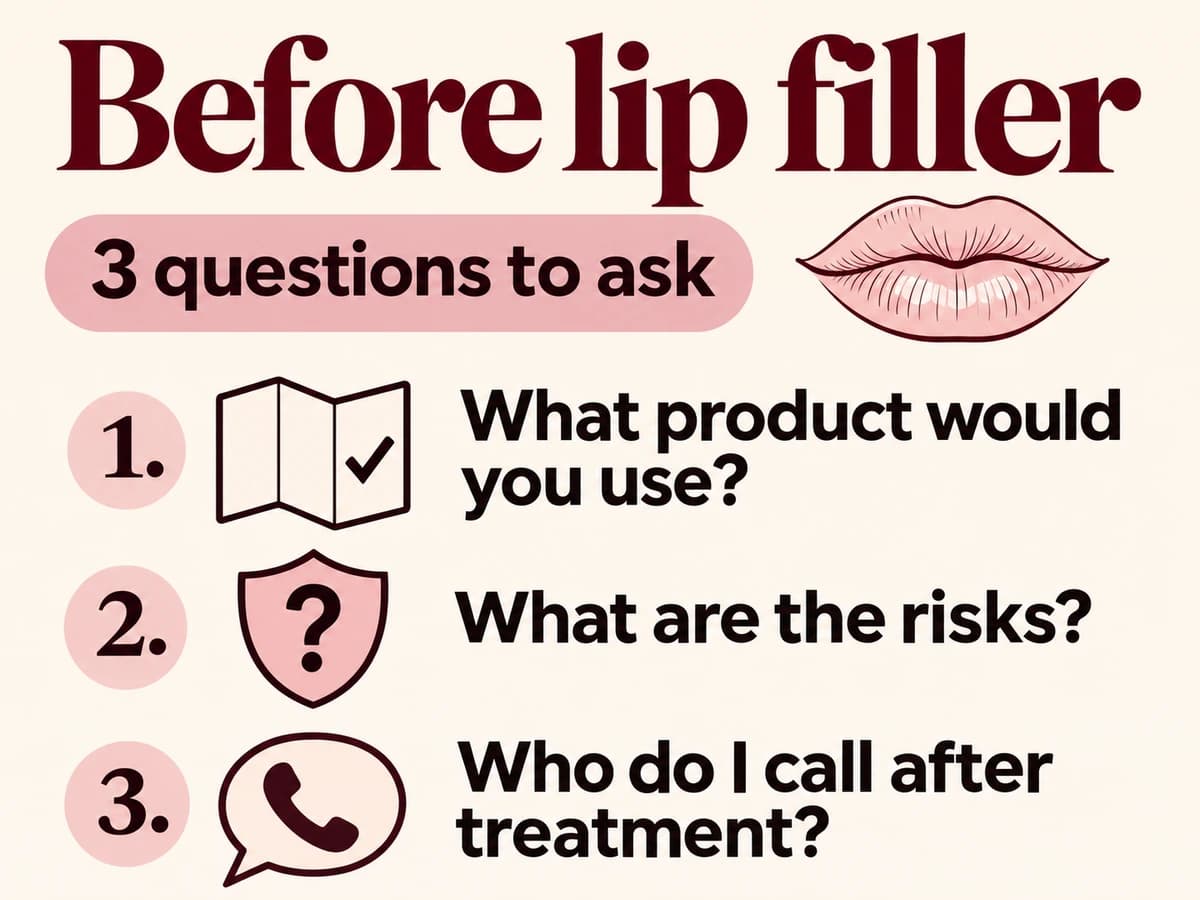
Before you agree to treatment, ask how the clinic handles complications and follow-up visits. Keep the product name, patient information sheet, aftercare instructions, and clinic phone number together.
- Which filler would you use, and is it FDA-approved for lips?
- Can I take the patient information sheet home to read before I decide?
- Is there anything in my health history, allergies, or medications that makes filler unsafe for me?
- What are the main risks for me, and how do you handle a complication?
- What signs mean I need urgent care, and who do I call after hours?
- When will we check the result, and is that visit included in the price?
- What can we do if I get a lump, or want the filler reduced or removed?
Sources 1 and 2, listed at the end of this page.
Private preview
Bring a picture of your goal to the consultation
- Free Natural preview · 8 previews $19 · 20 previews $29
- Private by default
- Delete on request
Sources and review status
Procedure terminology, U.S. labeling, FDA risk information and consultation questions. Sources checked on . This editorial reference has no clinical reviewer. Suggest a correction.
- Dermal Fillers (Soft Tissue Fillers) · U.S. Food and Drug Administration · source dated
- Dermal Filler Do's and Don'ts · U.S. Food and Drug Administration · source dated
- Restylane Kysse · FDA safety and effectiveness summary, P140029/S021 · U.S. Food and Drug Administration
- Lip Flip: What It Is, Results and Precautions · Cleveland Clinic · source dated